
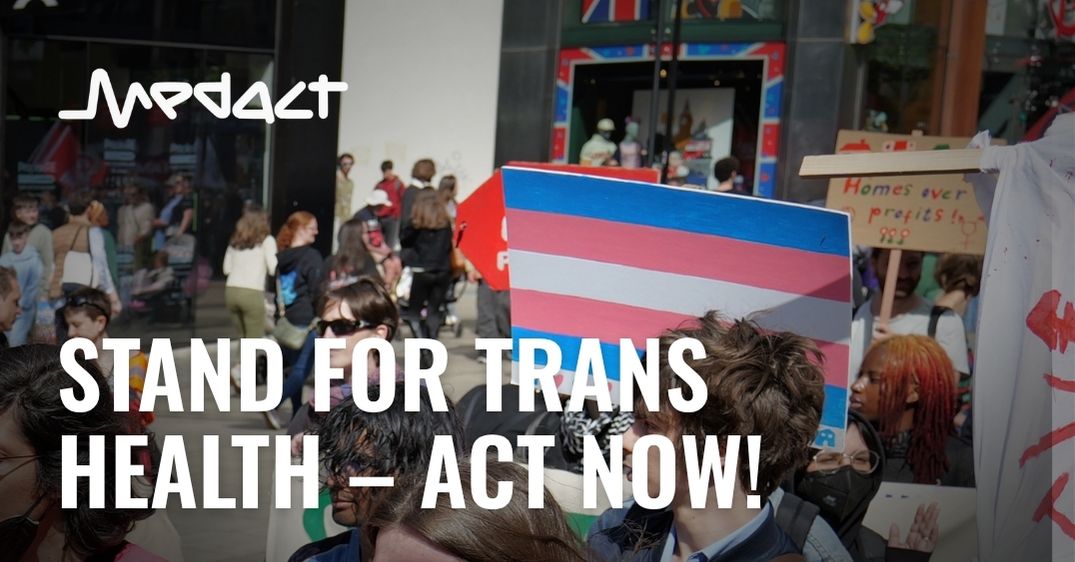
We are health workers across the UK committed to supporting and caring for trans people. At a time when trans healthcare is under attack worldwide – through legal restrictions, NHS delays and broader societal stigma – we refuse to stay silent.
We call on our colleagues to actively support trans people by:
- providing gender-affirming care – especially prescribing hormones
- advocating for accessible and competent health services
- refusing to comply with NHS restrictions.
Beyond our duty of care, we recognise the resilience of trans communities, whose knowledge and solidarity teach us how to create health systems that serve everyone.
By signing this letter, we affirm that we stand with trans people, we will fight for their right to healthcare, and we will learn from and work alongside trans communities to ensure life-saving care.
Note: Names of all signatories will be displayed on this page.
Health workers stand in solidarity with our trans patients, colleagues & neighbours
We, the undersigned health workers, offer our solidarity and recommitment to caring for trans people across the UK.
Trans people’s access to all forms of healthcare is under attack worldwide. These past weeks we’ve seen this vividly in the UK, from legal guidance restricting trans people’s access to hospital wards to the British Medical Association, the doctors’ trade union, dropping its opposition to the widely critiqued Cass Review.
These changes aren’t accidents or an objective expression of ‘reasonable concerns’. They’re happening amidst the largest trans health crisis in UK history, and a decade into a global moral panic targeting trans people’s rights, healthcare access and safety.
As health workers with a duty of care to our patients, we know trans health isn’t ‘controversial’ or ‘too complicated’. The skills we use to prescribe hormone therapy or look after our trans patients’ chest infections are the same ones we use for cisgender patients.
But in the current climate, it’s no longer enough to say we support trans rights, attend a trans 101 training, or wear a rainbow lanyard. We call on all health workers to join us in telling trans people across the UK: we stand with you, and we will fight for your right to healthcare.
Understanding the UK’s trans health crisis
As health workers with a duty of care to our patients, it is our responsibility to speak out and take action when we see health injustice being done – following the lead and expertise of people most affected.
Trans people are telling us loud and clear that they need our support in the face of a dire health crisis. We amplify trans calls to understand that:
- Attacks on trans healthcare are political, and affect us all: 27 US states have restricted trans healthcare over the past 5 years, some via the same legislation used to restrict or ban abortion. Trans patients’ experience of the NHS today – decades-long wait times, being forced to seek basic healthcare privately or abroad, or turning to ‘DIY’ health options – is a future we all risk facing with a rapidly privatising, not-fit-for-purpose health system.
- Trans healthcare is medically necessary – and it’s almost impossible to get on the NHS: A trans person referred to an NHS gender clinic today can expect to wait a third of their adult life for a first assessment, and many, like those on Glasgow’s Sandyford gender clinic’s 224-year waitlist, will never receive care. Over the past two years, young people have lost all access to transition-related care on the NHS.
- Health workers are being discouraged from caring for trans people, with devastating consequences: Trans groups report increases in GPs withdrawing existing HRT prescriptions, trans youth suicides after the puberty blocker ban, and over trans patients being denied access to non-gender-related healthcare for being trans. We know that the denial of trans healthcare results in serious harm to the mental and physical health of trans people.
- Trans people will always take care of each other, and the NHS must follow their lead: In the face of decades-long waiting times, trans people have developed harm reduction strategies, self-medication practices, and health resources that guide our understanding of trans health care. The UK’s gender services fall decades behind international standards of care, and are some of the most conservative in the world for countries where gender-affirming care is still legal.
Our commitments to trans people
We refuse to be quiet in the face of NHS and government rollbacks on trans healthcare – both direct attacks like withdrawing care from young people, and the cultures of silence and fear around trans people we see in our workplaces.
We encourage our NHS colleagues to join us in committing to:
- Prescribing hormone therapy for trans people, for those of us with prescribing power, and educating prescribing colleagues about their ability – and duty of care – to do so.
- Organising with our local trans communities to develop trans-competent GP surgeries and health hubs, resourced with patient accountability, specialist knowledge, and prescribing support. We point to GP surgeries in London and Brighton where GPs have partnered with trans-led organisations to provide patient-led care as concrete examples of this work.
- Refusing to comply in advance with further NHS restrictions on access to gender-affirming care, the same way we would refuse to comply with attacks on reproductive healthcare.
We call for these solidarity actions in part because we’re just doing our jobs. Our trans patients, colleagues and neighbours deserve care – and it’s our duty to provide it.
But we also offer our solidarity as health workers because we know we have so much to learn from trans communities. The care and mutual support amongst trans people – who are at the forefront of fights for equitable housing, racial justice, reproductive rights, Palestinian liberation, and the health and future of our planet – show us as a model for health systems that serve everyone.
We’re proud to stand alongside them in the fight for health justice.
Signed:
- Tracey Ann (Tam) Martin Fowles
- Guy Johnson
- Liam Torrens
- Imogen Stephens
- Mike Hope
- Juliette Brown
- James Smith
- Stephen Lancashire
- Jawad Anjum
- Stephanie David
- Joe Feely
- Tim Flynn
- Andy Middlewick
- Jessie Fairfield
- George Webster
- Linda Day
- Dr Zofia Witkowska
- Rosie Hollinshead
- Thorn Groves
- Dave Rendle
- Derek Marcus
- Birgitta Heiller
- Pam Wortley
- Jasmine Bennett
- Marcelin Kadembo
- Claire Rees
- Hilary Cornish
- Daniel Jones
- Zahra Youssef
- J James
- Emily Watson
- ANDY MEIKLE
- Loulou Clench
- Mike Griffin
- Kate Bowgett
- Rosemary Kate Hughes
- Rebecca Hotchkin
- Lavinia Porter
- Madeleine Kelly
- Danielle King
- N W Kenyon
- Heather Lambert
- Raj Tiwary
- Kate Danziger
- Béatrice Andrieu
- Rosie Marsh
- LIZ GODBER
- Elisabeth Murray
- Teresa Devereux
- Phillida Shipp
- Jenny Joyce
- Joanne Woolley
- David Jenkins
- Rob Gardiner
- Wanda Howell
- Anthony Collins
- Sinead Cook
- India Whalley
- Jo Markham
- Jessican Cox
- Thomas Wadsworth
- Rayah Feldman
- Rebecca Phillips
- Shiraz Hussain
- Mick Carpenter
- Moss Swordy
- Joanne McEwan
- Jane Wood
- Chris Goodswen
- Sara Ellis
- Steve Overton
- Mary Kellam
- Stefano Belli
- Lucy Aphramor
- James Vipond
- Valerie Briginshaw
- Gary Middleton
- Hilary James
- Christopher Brockwell
- Shelagh King
- Carol Thornton
- Chris Skrytek
- James Mark Collett
- Charlotte Neary-Bremer
- Haydyn Williams
- Rachel Clare
- Laura-Jane Smith
- Michael Defroand
- Olivia Agate
- Emma Torzillo
- Debbie Solomon
- Fay Gosling
- Jill Rapoport
- Kristien Hintjens
- Nadia Ellis
- Suzanne Elliott
- Sara Hagerman
- Christine Haigh
- Amy Rosenfeld
- Ellen Graubart
- Alice Blewitt
- Rebecca Nelsey
- Ellen Bradshaw
- Mike Higgins
- Keith Stenning
- Flora Malein
- Katie Morrigan
- Martin Drewry
- Ima Jackson
- Nazanin Rassa
- Sophie Ettinger
- Eleanor Clowes
- Helen Groom
- Borghert Jan Borghmans
- Ameen Kamlana
- FILOMENA MANTIO
- Mark Laffan
- Madron De Vicq
