



How can we disrupt the rollout and get the contract cancelled?
Check the status of your Trust or ICB in the rollout of Palantir’s platform
Introduction
The No Palantir in the NHS campaign is a grassroots worker, patient and community campaign to remove Palantir Technologies from NHS data infrastructure. It is organised by Health Workers for a Free Palestine in collaboration with Medact and in coalition with groups such as the Good Law Project, Amnesty International and Just Treatment.
Palantir is a software and AI company specialising in warfare, policing, surveillance and immigration enforcement. They are complicit in multiple human rights violations such as the genocide in Gaza, mass deportation and detentions by ICE in the US, military interventions in Iraq and discriminatory policing practices. You can read more about Palantir as a company and the concerns regarding the NHS contract in our briefing document.
The campaign has hundreds of members organising at the national and local level. We are demanding that NHS England cancel the contract with Palantir, which they could do at the upcoming contract renewal date in February 2027. We are also organising to hold our local hospitals and NHS institutions accountable and demanding that they don’t implement Palantir’s FDP at the local level.
We ground our actions in the political framing of health justice, and our campaign against Palantir originated in response to the call from Palestinian health unions to cut our institutions’ ties to genocide. Organising against the Palantir contract is not only a Palestine and migrant solidarity issue. The contract also represents an increase in the state’s ability to surveil health data, which we know will impact marginalised patients the most. It also furthers privatisation and outsourcing of NHS services, and enables corporations to extract and profit from our health data.
The increasing militarisation, privatisation and surveillance of our health services are part of a wider picture of colonialism and capitalism. We aim to weaken Palantir, a key supporter and enabler of state violence, as well as resist the ongoing outsourcing, asset stripping and privatisation of the NHS and the expansion of state surveillance technologies in the UK.
What are the key messages of the campaign?
- The contract with Palantir furthers the outsourcing, privatisation and asset stripping of the NHS – This contract enables a private corporation to become embedded and essential to the functioning of health data systems. The money spent on the contract would be better spent developing trusted and effective internal publicly-run data systems.
- Palantir are an unacceptable partner – The NHS cannot partner with a company complicit in genocide and multiple human rights abuses. Palantir will benefit significantly from this contract, which could potentially lead to NHS health data being used to improve and strengthen technology that is used for human rights abuses and war crimes.
- Palantir’s FDP will damage patient trust in health data and furthers capacity for state surveillance. The FDP expands capacity for state and corporate surveillance of health data, and there is no patient opt out. Palantir is known for human rights abuses and state surveillance. This will lead to a lack of patient trust in the FDP and other health data systems, with known negative impacts on care.
Helpful links and contacts
Support is available for research (e.g. what has been happening in my trust with Palantir) and advice on messaging, community organising and strategy. The Palantir campaign holds monthly meetings where local campaigners can send representatives for discussion and shared learning, and has a Signal group for us to share knowledge.
- Please let us know if you set up a local group so that we can direct people to you if they approach us and we can add a representative to this group, and reach out if you would like support, advice or research.
- You can reach us via Medact, Just Treatment, Health Workers for a Free Palestine, Health Workers for Palestine and Patients not Passports organisers.
- You can also reach hw4fp directly via email at: [email protected]
This online tool, developed by Good Law Project and Just Treatment, is for NHS patients, staff, and the public to complain about the FDP to their local NHS organisations.
You can also find out whether your NHS trust or ICB is currently rolling out FDP products!
You can pass motions at your local union branch using the Just Treatment model union motion.
Helpful articles and powerful reading
- NHS England must cancel its contract with Palantir | The BMJ
- How is your health data linked to Israeli occupation? | SHADO
- Corporate Watch report on Palantir:
- All Roads Lead to Palantir | Privacy International
- The NHS as a site of structural violence | SHADO
- Secrets of a Successful Organiser | Labour Notes
Leaflets
You can leaflet at local community events, Palestine marches, and outside hospitals, you can use one of our pre-developed leaflets.
How can we disrupt the rollout and get the contract cancelled?
We believe the weakest link in the rollout is at the local trust level, where it will be clear that communities, patients and workers will not accept this contract.

There are ongoing legal challenges to the contract by Foxglove and Good Law Project. Many open letters to NHS England, including from high profile doctors and law firms, have been unsuccessful. We are and will continue to work with NHS England staff members who are opposed to the contract, but must build power in our workplaces and communities to get this cancelled.
The rollout of the FDP is heavily dependent on each trust adopting it, and developing local ‘applications’ using it. The FDP will sit above all of this, integrating data that it obtains from the applications. These two diagrams are taken from NHS England:
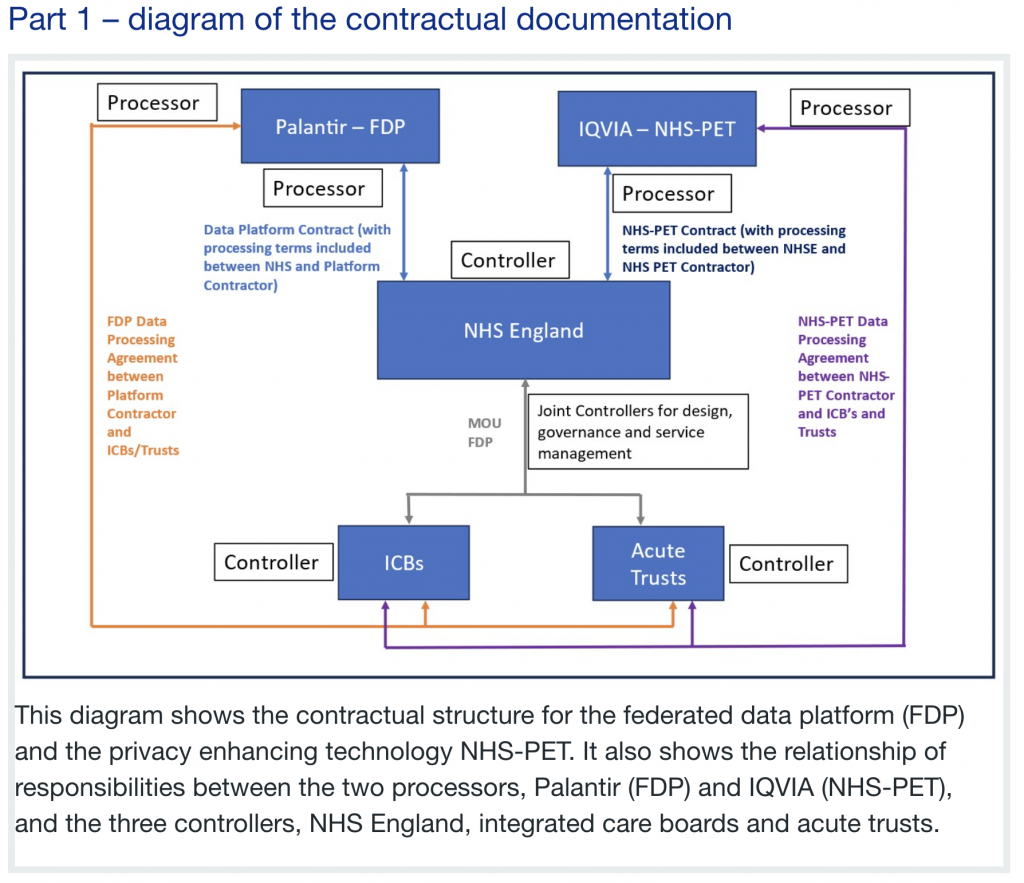
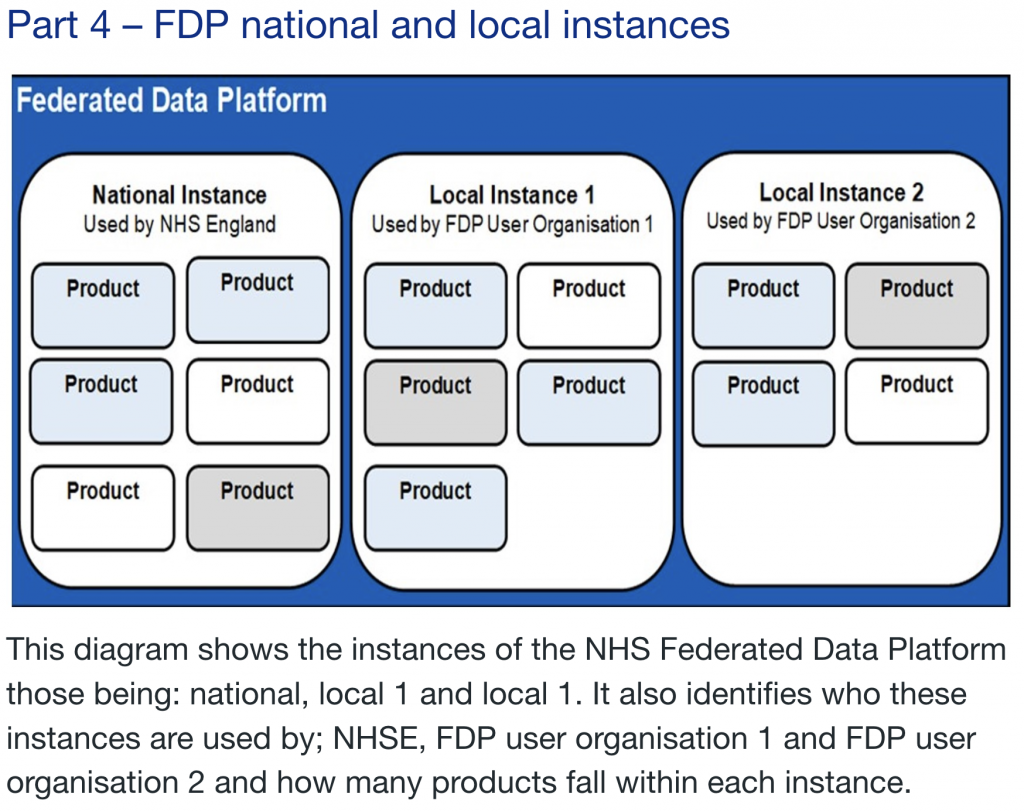
Initially, the rollout began with pilot trusts developing the FDP. Each trust and hospital will use it slightly differently, and some have been working directly with Palantir to develop functions, such as Chelsea and Westminster’s ‘Cancer 360’ application. The ‘products’, developed and piloted at trusts, if successful, will be rolled out or offered to other trusts across England. In trusts where the FDP is being piloted, the Palantir app and Palantir login have started appearing on trust computers.
Here are some of the products we know about so far, both in development and already available (if you are reading this and you know of others please get in touch so we can update this list):
Live
- Optimised Patient Tracking & Intelligent Choices Application (OPTICA) – Discharge planning; “[provides] real-time tracking and task management for patient discharge processes”
- Inpatient 360 – “streamlines elective care with data insights to improve theatre use and support planning, improves data quality oversight and waiting list validation”
- Outpatient 360 – “enhances clinic operations with waiting list validation”
- Referral to treatment (RTT) validation – “facilitates RTT pathway accuracy and progression”
- Elective Care Coordination Pilot (IECCP)
- Care Coordination Solution (CCS)
Incubation period
- AI Discharge Summaries
- Assisted Theatre Scheduling
- Equipment Tracking
- PLV
- Pre-Operative Assessment
- Radiology Bookings Productivity
- Shared PLT
- System Control Centre
- Timely Care Hub
Pilot
- Cancer 360
Concept stage
- Cancer Waiting Times
- LLM Clinical Letters
- Person Level Costings
- System Analytics Workbench
- Virtual Wards
Not Started
- DNS Prediction
- Patient Initiated Follow Up
Other
- Mutual Aid
Which trusts are rolling out FDP products?
By November 2023, we had info on some initial trusts progress, plus plans for the national rollout. By January 2024, we had more info on specific trusts’ progress and what products they had, and we knew there were 42 trusts piloting the FDP in some way.
Trusts that we know are piloting Palantir software:
- Chelsea and Westminster NHS Trust
- Croydon Health Services NHS Trust
- Great Western NHS Foundation Trust
- North Tees and Hartlepool NHS Trust and
- University Hospitals Dorset NHS Trust.
By March 2024, we knew there were 29 new trusts being prepped. We sent a Freedom Of Information request to NHSE for the names of the (now known number of) 44 trusts, and the 29 more intended to have gone live in summer 2024. We were refused on the grounds that this information was supposed to be published in summer 2024 on NHSEs own website; this has not yet been published.
Originally, adoption of the FDP was going to be voluntary. In August 2024, NHS England announced it would be mandatory for trusts to implement the FDP, giving them only a few days to confirm their plans and two years to implement them. NHSE mandating the use of the FDP is highly unusual and problematic, with unclear legal basis. Since then, over half of acute trusts have signed up to implement the FDP.
Our most recent FOI to NHSE regarding the (still unpublished) list of trusts actively rolling out the FDP, and Palantir’s products, was partially answered and we were given a list of trusts known to be in early engagement in March 2024. We were also successful in getting a list of integrated care boards (ICB) that have formally agreed to join the NHS FDP Programme via completion of a Memorandum of Understanding in October 2024. Again, this is a snapshot in time and can change regularly.
What are the key messages of the campaign?
- Palantir are an unacceptable partner – The NHS cannot partner with a company complicit in genocide and multiple human rights abuses. Palantir’s AI will benefit significantly from this contract, which could potentially lead to NHS health data being used to improve and strengthen technology that is used for human rights abuses and war crimes.
- The FDP, especially with Palantir leading, will damage patient trust in health data and furthers capacity for state surveillance – The FDP hugely expands capacity for state and corporate surveillance of health data, and there is no patient opt out. This is exacerbated by the company running it being Palantir, known for human rights abuses and state surveillance, which stands to benefit significantly from this contract. This will lead to a lack of patient trust in the FDP and other health data systems, with known negative impacts on care.
- The contract with Palantir futhers the outsourcing, privatisation and asset stripping of the NHS – This contract enables a private corporation to become embedded and essential to the functioning of health data systems. The money spent on the contract would be better spent developing trusted and effective internal publicly-run data systems.
Key demands for NHS England
- Cancel the contract with Palantir
- End the outsourcing, privatisation and asset stripping of the NHS
- End all contracts with companies complicit in the Israeli occupation
(There are multiple other BDS target possibilities within the health system. We have focussed on Palantir as a strategic target but others include (but are definitely not limited to) big tech companies, Oracle and Infosys.)
Additional demands for trusts and hospitals
- Do not implement the FDP locally and/or pause any existing rollout plans
- Raise these concerns nationally and oppose the enforced rollout on all trusts
- Publicly and clearly communicate the trust’s position on the FDP
- Explain whether – and how – patients can opt out of including our data in the FDP
How can I get started?
Organise a local group
- Find a group of people in your local area who care about Palestine, data privacy, migrant rights in the NHS, surveillance, privatisation or all of them!
- Take your time to get to know each other and set shared aims and intentions. This is an important issue, but we also have time (years) to build resistance to it, so you don’t need to rush.
- Once you have your core group, you can start regular meetings and brainstorm how you would like to approach this in your area.
Please let us know if you set up a local group so that we can direct people to you if they approach us and we can add a representative to the Palantir campaigning Signal group.
Gather information
- Check your Trust or ICB’s reply to our FOI regarding the planned uptake of the FDP in the database below!
- Here is the NHSE list of trusts which are currently active with the FDP
- Here is the NHSE list of trusts and ICBs signed up to the NHS FDP
- This FOI response shows which trusts have signalled ‘Intent to adopt the FDP’
- Submit extra information about your trust or ICB if the information in the database is out of date
Build relationships
- A lot of health workers feel nervous or scared to organise in their workplace. Doing things together helps to build up trust and confidence, and reassures you that you can do political organising together.
- You could start with discussions about issues in your workplace that people feel strongly about, such as migrant charging for healthcare, data privacy and Palestine.
- You could gather people together to read this toolkit and discuss it together.
- You could start by running political education events or workshops on Palantir and the NHS contract. Get in touch with Health Workers for a Free Palestine if you would like help with this – we have workshop templates!
- You can leaflet at local community events, Palestine marches, and outside hospitals – use one of our pre-developed leaflets! Click here for leaflet one | Click here for leaflet 2
- You can pass motions at your local union branch using the Just Treatment model union motion.
Campaign
- You could use our draft open letter, adapt it to your local trust/hospital, and gather signatures from health workers to the board of trustees.
- You can work with community leaders, local Palestine solidarity groups or other groups to encourage people to send in patient and public complaints using the Good Law Project and Just Treatment online tool, or writing their own letters and leafleting at hospitals.
- You can approach your local union representatives (such as the Local Negotiating Committee of the BMA) to ask them to support the campaign, by signing the letter and raising the issue at their regional and national union meetings. You can also use this example union branch motion.
- You can approach your local union representatives to discuss the possibility of staff refusing to work on the FDP (i.e. less-than-strike action targeted at the FDP). We are also exploring this at the national level.
- You can lobby your Royal College or other professional body as a group of specialist doctors asking it to object to the contract.
- You can map and join local health and community engagement committees and meetings, such as integrated care board (ICB) meetings.
- You can lobby your local council and local MPs to object to the FDP roll out in your local area.
Draft open letter to trustees
This letter is written as if it was from NHS staff, but it can be adapted to any group! This draft letter is long, so feel free to edit it and adjust to your local context.
Who to write to:
- You can map the relevant people with power in your hospital or trust. This may include: trust CEO and trustees, trust data officer, clinical director, trust COOs, directors of transformation and improvement, exec/non-exec teams, and trust ethics/procurement teams.
We are writing to you as members of staff at [insert hospital/trust/location] to express our deep concern at the rollout of the Federated Data Platform (FDP), and the supplier of this technology, Palantir. As we will outline below, we believe this contract represents a serious threat to NHS values and trust values, and undermines our commitment as health workers to promote public health, medical ethics, patient trust, good data governance and fair procurement.
[Insert paragraph on current situation at trust (adjust depending on how much information available, please contact hw4fp research team for support if needed):
- We are aware that X hospital has participated in the pilot scheme
- We are aware that X hospital has begun using X applications
- We are aware that the Palantir logo has started appearing on trust computers
- We are aware that NHS England has mandated all trusts to confirm their plans to roll out the FDP over the next two years]
[Given X trust’s commitment to (insert various trust statements, in particular on anti-racism, inclusion, child health, etc)], we hope that the trust will object to the roll out of the FDP, and support ethical, safe and fair data management systems.
- Palantir, the provider of the FDP, is likely complicit in human rights abuses, war crimes and genocide
Palantir is a US tech company which specialises in AI-powered military and surveillance technology and data analytics. Palantir describes its military technologies as offering customers “mission-tested capabilities, forged in the field” to deliver “a tactical edge – by land, air, sea and space”.
Palantir has a long history of using its technology to facilitate human rights abuses across the world. It supported the US government to track and deport migrants at the Mexico border, including in forcibly separating children from parents. It provides predictive policing services to the US police force, shown to disproportionately target Black communities. It provided services to the US military for wartime operations in Iraq and Afghanistan, in particular drone strikes, which are known to have targeted civilians.
Most recently, Palantir is currently supplying the Israeli military with “advanced technology provision” in support of war related missions. Palantir’s CEO Alex Karp says he is “exceedingly proud” of Palantir’s involvement in what he calls “operationally crucial operations in Israel” keeping Israel “armed and ahead”.
The most recent International Court of Justice (ICJ) ruling regarding Palestine came in July 2024, with an Advisory Opinion that declared Israel’s occupation of Palestine unlawful under international law, specifically mentioning forcible transfer, racial discrimination and apartheid, and it called for Israel to withdraw immediately. The ICJ also laid out directions for the responsibility of states and international organisations and stated that failing to act was furthering ‘genocidal violence’. In relation to the ICJs case on genocide it said that if states didnt cease their aid and assistance to Israel’s acts, they would be complicit, and this includes transfer and trade that contributes to Israel’s military. By supplying advanced AI technology to the Israeli military, it is likely that Palantir is complicit in war crimes and genocidal violence.
With all of the above evidence, we hope that the trust will agree that Palantir is an unacceptable partner for the trust and NHS England, and rolling out its technology in the FDP will undermine the trust’s commitments to [insert] and damage patient relationships. It will also compromise our commitments as health workers to protecting, promoting and maintaining the health, safety and wellbeing of the public, and promoting and maintaining public confidence in the medical professions.
- There are serious concerns about the data privacy, data management, and data ethics of the FDP
Many leading medical and data ethics experts have voiced alarm at the supposed safeguards put in place to protect patient data within the FDP, including the BMA, who wrote to the government last year arguing: “The public and the profession have not been adequately consulted and reassured, and the scope and scale of the programme do not appear to have been sufficiently established.” The lack of trust over how patient data would be handled gave the BMA concerns that it would fatally undermine the project.
The NHS has sought to reassure patients that their data will be safe because it is “pseudonymised” or “anonymised” but the level of detail in a health record means such data can never be truly confidential, with a small number of data points being enough to reveal the identity of the patient. Furthermore, pseudonymisation is designed to be reversible, and is still regarded as personal data by the Information Commissioner.
These weak reassurances, along with the lack of clarity around the applicability or otherwise of the national data opt-outs to the FDP mean that there are persistent fears over the data privacy protocols to be implemented by the NHS, Palantir and others involved in the project.
There is a dangerous track record of data being shared across government departments to target vulnerable communities including migrants and refugees, including NHS patient data. Campaigners are rightly alarmed that the FDP will make this even easier, especially as Palantir has multiple relationships with departments across government, and there is still so much uncertainty about the full scope of the FDP and uses of the data collected within it.
These legitimate concerns over the way NHS patients’ data will be used within the FDP are exacerbated by the multiple inconsistencies and gaps in information communicated to the public about the way data will be held, for what purpose, and with what safeguards over its use.
This lack of trust in the FDP – particularly one run by a private company like Palatir – is a serious concern, as it risks undermining the potential benefits to be realised from effective, trusted use of health data for planning and care. This threat was highlighted by Dr Nicola Byrne, the National Data Guardian, who argued that the lessons must be learned from the failures of past data centralisation efforts such as care.data and GDPR if mass opt outs are not to undermine the FDP. This risk could play out, with 48% of adults in England who have not yet opted out stating in response to a YouGov poll, commissioned by Foxglove and the Doctors Association, that they are likely to do so should the Federated Data Platform be introduced and run by a private company.
Such mass opt outs not only undermine the quality of the data for researchers, but are also likely to entrench health inequalities as more people in some ethnic minority communities are likely to take this step, reducing their visibility when health planning is undertaken. Failing to do this with informed consent and support from patients is going to worsen health outcomes for many within the UK – even if the FDP reality matches the hype.
The involvement of Palantir only adds to these concerns. It has supported the US spy-agency NSA and UK spy-agency GCHQ in software for mass surveillance of populations, and was linked with Cambridge Analytica in its operations to collect data on Facebook users and interfere in the Brexit referendum.
Previous contracts with Palantir and the NHS have involved sharing including dates of birth, postcodes and detailed medical histories. Despite claiming that Palantir would not have access to “identifiable medical records”, NHS documents obtained by openDemocracy admitted that the company will “collect and process confidential patient information”. This dishonest or inaccurate communication about its historic access to patient data significantly undermines trust in the NHS’s current assurances that Palantir won’t have access to this data in the FDP.
Even if there was total clarity about the safeguards in place, and a public commitment to the highest standards of data privacy and ethics, it would – according to Conservative MP, David Davis – make little difference: “Bluntly, it is the wrong company to put in charge of our precious data resource; even if it behaved perfectly, nobody would trust it.”
The opportunity to test and develop its software in the NHS is a highly valuable resource in itself, which Palantir could profit significantly from. Amnesty International highlighted: “Even if (Palantir) cannot walk away with direct patient records, they can walk away with the lucrative AI models built from those records.” Research by Privacy International and No Tech for Tyrants into rare, unredacted contracts, shows that Palantir seeks to include “improvement clauses” in its agreements with governments, enabling it to improve its algorithms or systems based on its customers’ use of its products. With NHS data therefore likely being used to strengthen Palantir’s tools, this could ultimately result in the NHS contributing to the advancement of technology used to commit human rights abuses and war crimes, including in Gaza by the Israeli state.
With all of the above evidence, we hope the trust realises the threat to data privacy this contract presents, and the potential follow-on damage to patient trust in all health data systems. Previous software rollouts have been paused and reversed due to patient and health worker concerns over data privacy, and we believe the FDP will meet the same issues. We believe the government has failed to uphold its legal obligations to secure informed consent for the use of patient data, demonstrate the legal footing for the FDP, and adequately address the concerns of doctors and patients alike.
- We have serious concerns about the privatisation and outsourcing of health data management systems to corporations
We have serious concerns that such an important NHS function as data management systems is being outsourced to a private company. Locking the NHS into a single monopoly supplier holds severe risks, especially when Palantir themselves have stated its intention to monopolise government contracts with its technology. Palantir’s software cannot be transferred to another company or back onto NHS systems easily. This means that the whole of NHSE’s integrated data system will be stuck on Palantir’s systems or will need to be rebuilt from scratch. This exact issue played out when the NYPD tried to end its use of Palantir’s technology. This is neither democratic or competitive, and will result in one private provider dominating the data management systems of the NHS. In January, 2023 Palantir CEO Peter Thiel described Britons’ affection for the NHS as “Stockholm syndrome” and urged the government to “rip the whole thing from the ground and start over”.
The procurement process for Palantir raises serious concerns for mismanagement, ministerial intervention and unfair procurement processes. Palantir initially entered the NHS by providing its services for just £1, in a contract that was given without competitive tender. The Health Minister at the time, Matt Hancock, used special ministerial powers to bypass patient confidentiality rules and allow the company to process patient data. In the following months, Palantir was handed several more NHS data and digital contracts, all while normal procurement procedures were paused.
This gave Palantir significant advantages in the FDP procurement process. Palantir was referred to as the recipient even before official decisions had been made, an email exchange from 2020 revealed, leading to accusations of an unfair procurement process for the FDP. In addition, NHS England’s decision to mandate the use of the FDP is highly unusual, and has an unclear legal basis.
We hope the trusts agree that this raises serious concerns of an unfair procurement process, putting vital NHS resources at risk of failing to secure value for money. Instead of outsourcing valuable financial and personnel resources, and locking in dependency on private companies, we believe the NHS, and the trust, should focus on developing strong in-house data management capabilities.
Our requests to the trust are as follows:
- Do not implement the FDP locally and/or pause any existing rollout plans
- Raise these concerns nationally and oppose the enforced rollout on all trusts
- Publicly and clearly communicate the trust’s position on the FDP
- Explain whether – and how – patients can opt out of including their data in the FDP